Nobody Wants an Electric Edsel
Posted by James Ruppert | Sep 26, 2025 | Articles, Brown Car Guy, Electric Cars, News, Politics
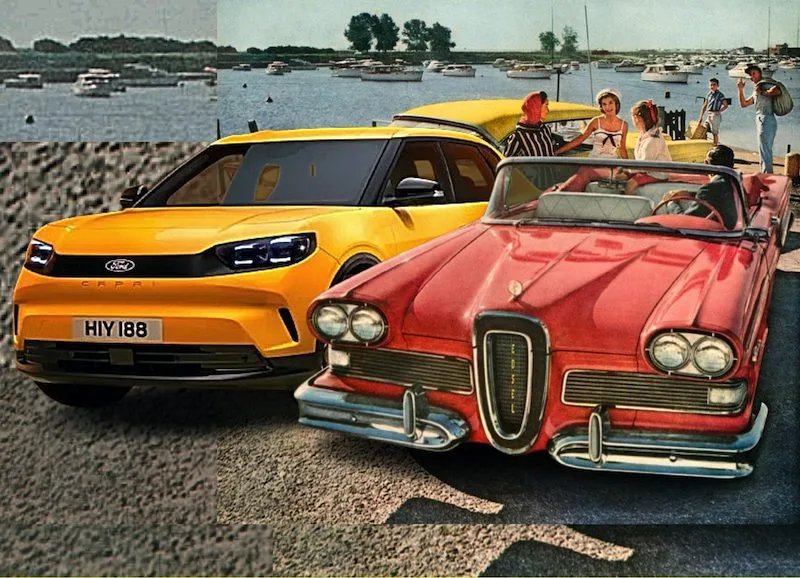
Nobody Wants an Electric Edsel
We did try to tell them…
Here we are, several years down the line and we hate to say, ‘we told you so’, but we bloody well did.
Let’s go back 57 issues to number 91 https://cdn.lumara.digital/freecarmag/magazine/Free-Car-Mag-Issue-91.pdf
Worth a quick look if you want to see what we were saying back then. The cover really should tell you more than enough, but the features and there are more than enough, predicted what is happening today. We were also keen that you sign a petition that sought to reverse the 2030 diesel and petrol car ban. I wonder how that actually went?
From a purely personal point of view, I was finding it a challenge to be a columnist in a major mainstream motoring magazine and stay quiet. Although electricity cars were not my actual remit, I did have the ear of the editor. I told him it was all going tits up for battery cars and after many requests to warn readers about the coming batterygedden I was given the green light. Permitted to write a balanced feature about the pros and cons of going electric, the plug was pulled before it could go in the magazine. Too controversial apparently. Prescient, I would say, but then I would, wouldn’t I?
After that it was downhill for me. I made a point of not recommending or writing about electric cars, just serving the readers by keeping it real, the good value ICE cars that did not have an expiration date. I didn’t help myself by talking to alternative motoring pundits like the brilliantly topical and successful Geoff Buys Cars (on You Tube and Twitter) and then I wrote a paper for Net Zero Watch https://www.freecarmag.com/the-war-on-the-car-with-net-zero-watch
Meanwhile in Europe, Ford, who rarely put a tyre track wrong in this market over the decades seemed to have cocked it all up big time. For a start they are part of the death of the small car. The Fiesta had to go because of the daft European CO2 mandate steering the car industry towards zero emissions. Small cars always meant small profits, but the mandate meant better to build a genuinely profitable SUV and not be penalised in the process. Obviously there were excuses made about its demise in 2023 focused on the microprocessor shortage and the arrival of the sexier Puma. The switch to electricity was also a big part of the narrative, even if they didn’t have a pocket sized one. We needn’t have worried though because Ford had a plan.
I’m sure the plan wasn’t necessarily to shed 1,000 jobs, although that is always an easy way to save money. Anyway, the workers affected are based at the Cologne Electric Vehicle Center in Germany, where the Capri and Explorer Electricity vehicles are assembled. Those two models are reworked versions of the Volkswagen ID.4 (Explorer) and ID.5 (Capri). Ford claimed that electric vehicle demand was “significantly below industry forecasts.” Over at the Wall Street Journal they also cited others who could be blamed for all this, governments, as constantly changing regulations, falling or non-existent subsidies and a lack of charging infrastructure investment. The Cologne plant is supposed to be down one shift by next January and many might remember last year when 4,000 jobs were planned to be cut in Europe anyway.
Ford are American and could be forgiven for being a bit out of touch with the way things work in Europe. There is no such excuse for the cool types that run Porsche. Reading their recent press release is certainly interesting as they use some interesting buzz words. They regard “electromobility as an essential drive type of the future. Due to the slower ramp-up of electromobility and changed framework conditions in China and the USA, the sports car manufacturer is realigning its battery activities: In this context, the Cellforce Group GmbH is to focus on the research and development of battery cells in the future.”
So what does that actually mean? Well, for the workers it is “socially responsible support for staff reductions at the Cellforce Group”, great for them I suppose. Porsche is though sticking to its electric course. However, the company is developing new combustion-powered 718 models for the end of the decade, but the electric Boxster and Cayman are still on course, possibly because they’ve put too much in it to turn back. They are aware and said as much during financial reports they made earlier in September postponing the launch of EVs due to a lack of growth in demand and uncertain market conditions. Their giant Cayenne won’t be an EV now and it seems that Hybrid is going to be the only acceptable way forward went it comes to the showrooms in 2027. The Taycan in particular has been a huge wake up call for the company which was not adopted in the numbers hoped and whose residual performance has been underwhelming.
BMW have also double backed on an all electric future, but you knew that already. They all are, if car manufacturers don’t wake up and dump electricity the Chinese will simply take over the car industry slightly earlier than expected. Oh dear, I’ve just seen this…

Which raises the question. Where are people buying EVs in the UK? We linked up with Data News to find this out.
The poshest parts of the country are leading the charge into electric vehicles – with poorer and remote areas finding it impossible to justify the expense of a battery-powered car.
New figures from the DVLA have revealed which areas of the nation are seeing private owners embrace the push to electric cars and which places are turning their backs on the eco-vehicles.
The data shows drivers in the wealthy areas of central London are 50 times more likely to own and run an EV than people in poorer more rural areas of the nation.
The data shows that among almost 3,000 postcode areas in the UK the ten with the highest proportion of EVs are all in London, where in some places one in ten of all privately-owned cars is electric.
At the other end of the scale Middlesbrough, some of the Scottish islands and large areas of Northern Ireland all have a tiny number of EVs.
The popularity of the electric vehicles in London has been accelerated by the fact they divert around the capital’s £15-per-day Congestion Charge and the £12.50-per-day ULEZ fees, as well as being well supported by a booming charging network.
In places where EVs are less popular the high price of the vehicles as well as people tending to do longer daily trips has also been seen to be a deterrent to people getting one.
Overall the DVLA figures show around 210,000 battery-powered cars among the total of 33.5million cars registered to private owners in the UK.
Six of the top ten areas for privately-owned electric cars are in Westminster, in Central London, where around one in ten of all cars is battery-powered.
At the other end of the chart six of the ten areas with the slowest update are all in Northern Ireland where only around one in every 500 privately owned cars is an EV.
The ten places with the highest proportion of privately owned EVs:
Postcode Area Percentage
W1B, Westminster, London 12.7
N1C, Marylebone, London 10.9
W1U, Marylebone, London 10.7
W1D, Soho, London 10.4
W1S. Mayfair, London 10.4
W1T, Fitzrovia, London 10.3
W1G, Harley Street, London 9.0
NW3, Hampstead, London 8.9
NW8, St John’s Wood, London 8.5
EC2A, Shoreditch, London 8.3
The ten places with the lowest proportion of privately owned EVs:
Postcode Area Percentage
BT77, Augher, Mid Ulster 0.16
TS1, Middlesbrough town centre 0.16
BT82, Strabane, N. Ireland 0.18
BT69, Aughnacloy, N.Ireland 0.18
BT78, Omagh, N. Ireland 0.19
BT81, Castlederg, N.Ireland 0.20
BT75, Fivemiletown, N.Ireland 0.21
LL45, Llanbedr, Gwynedd, Wales 0.22
HS1, Stornoway, Outer Hebrides 0.22
PA42, Port Ellen, Isle of Islay 0.24
Outside the capital other places with a high-proportion of privately owned EVs included central Glasgow, Edinburgh, Cambridge and Beaconsfield, in Bucks.
Other places where private owners are slow to adopt EVs are parts of Birmingham, Hull, Cardiff and Plymouth.
The DVLA figures show there are 210,000 EVs among the nation’s 33.5million privately owned vehicles.
The figures do not include vehicles registered to businesses and firms, which typically own newer vehicles.
Running a EV in the London area is almost a no brainer. Short journeys, lots of charging points and freedom from having to pay a Low Emission Charge. It helps to be rich and have off street parking access too, it help makes the school run much more convenient. Despite there being some great new and used offers postcodes where there is a limited charging infrastructure makes owning an EV more risky. The distances covered in outlying postcode areas means that running an EV is more of challenge. Certainly for older, retired drivers with decent pensions, if they can charge at home for pennies and use it for cat food runs then electric also makes sense, but they are in the minority.
What have we proved here then? This is a case of us and them, those who can afford and EV and those that can’t afford one for practical and financial reasons. Meanwhile car manufacturers lose money and the workers lose jobs because the wrong decision was made.