2026 Suzuki e-Vitara
Posted by James Ruppert | Jan 3, 2026 | Articles, Brown Car Guy, Electric Cars, New Model
2026 Suzuki e-Vitara Review – India’s First Global EV Lights Up the UK!
Suzuki’s first electric car is made in India! The e-Vitara blends a Desi heart with Japanese engineering precision, and right now it’s one of the best EV bargains on sale in Britain.
Japanese car companies have always been on the leading edge of engineering. Innovating, developing, breaking new ground – surging ahead of the crowd in surprising new ways. And Suzuki’s latest new car… doesn’t conform to any of that. Well, apart from the ‘surprising’ bit.
Because the new e-Vitara isn’t truly Japanese at all. It’s more like a takeaway tikka delivered by a samurai. And given how much Brits love a good curry, Suzuki’s first fully electric car – designed and built by Maruti Suzuki in Gujarat, India – rolling off the boats onto our roads at barely believable prices, is surely going to go down a treat.
Think of the new E Vitara as Bollywood meets Bullet Train – Japanese efficiency with a little bit of desi masala. Suzuki may be late to the EV party, but they’ve turned up with mithai and manners.
It’s built on the brand-new Heartect-e platform – purpose-engineered for electric power. Suzuki plans to shift around 8,000 units in 2026 and capture up to 8% of the small electric-SUV segment.
The e-Vitara starts at £29,999 for the 49 kWh Motion 2WD, rising to £37,799 for the top-spec Ultra ALLGRIP-e 4WD.
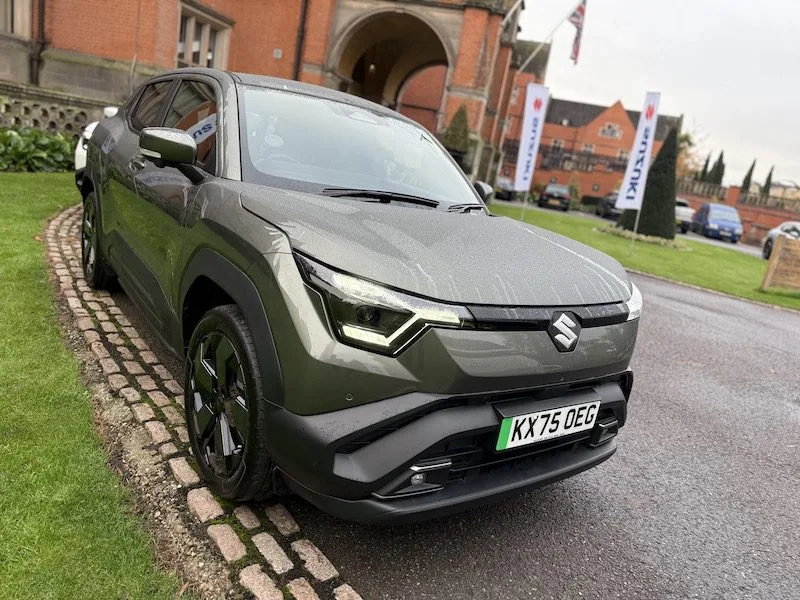
It’s got presence – chunky futuristic styling, gritty angular lines, and a stance that belies its relatively diminutive size (4.3 metres long, 1.8 metres wide and under 1.7 metres tall).
But there’s something curious about it: it doesn’t look like any Vitara we’ve seen before, and makes its regular sibling look dated even as it continues alongside for the foreseeable. And yet, somehow, you readily accept this as a new Vitara.
Suzuki calls this their “High-Tech and Adventure” design language. Upright stance, compact size, crossover SUV proportions – yet more purposeful. The grille-less nose and matrix LED headlights give it a sharp, determined, but approachable visage. There’s 185 mm of ground clearance, big-fendered wheel arches and those large 19-inch alloys (though I feel 18s might sit better aesthetically).
Step inside, and there’s an immediate sense of quality – smart, contemporary, but not pretentious. Yes, there are twin 10-inch-plus screens ahead of you running all the usual infotainment features, and yes, you can even download an app to manage your electric Suzuki. But thankfully, you also still get proper buttons and knobs.
A tactile volume dial and toggle switches sit neatly below the screen, while the steering wheel is joyfully packed with buttons. The materials mix soft-touch plastics and synthetic leather, with tan accents adding a subtle premium vibe.
I can sit behind my own six-foot-plus frame, and the 160 mm sliding and reclining 40:20:40 folding rear bench offers unusually versatile comfort – though you do perch a little high, and I managed to bang my head getting out. Boot space starts at just under 300 litres and expands to over 560 litres with the seats folded. There’s also a useful underfloor compartment for your charging cables and odds and ends.
You’ve got two battery choices. The entry-level 49kWh version delivers 144bhp, 193Nm of torque and a 213-mile range, with 0-62mph in 9.6 seconds.
The 61kWh version ups power to 174bhp (same torque) and stretches the range to 264 miles – the longest of any e-Vitara.
Then there’s the ALLGRIP-e four-wheel-drive version, with 183bhp and a hefty 307Nm of torque, slicing the 0-62 time to 7.4 seconds. Range drops slightly to 245 miles, but that’s a small trade-off for real all-weather traction.
We drove the 61 kWh Ultra 2WD on the road, and it feels light on its feet – responsive and comfortable. Steering has decent weight, pleasantly meaty if not brimming with feedback. The ride is typically EV-rigid: well-damped on smooth tarmac, it does transmit the bumps and ruts a little too eagerly on poorly surfaced roads. The 19-inch wheels don’t help much either. They look good though.
It’s not trying to be a hot hatch, but performance is brisk and satisfying – with a linear delivery – more refined than raucous. It’s accompanied by the sci-fi whine of an R2-D2 toked up on bhang! In Sport mode, throttle response tightens slightly. It’s well composed and relatively neutral through fast corners.
Visibility is excellent up front; the rear window is partly blocked by the headrests and those stubby mirrors could be larger, but the reversing and 360-degree camera system makes parking a doddle.
It feels compact and manageable on narrow British lanes. On the motorway, there’s some wind noise, but road roar is well suppressed.
We got to do some mild green laning and playing around on open fields in the range topping Ultra ALLGrip-e, only available with the 61kWh setup. The dual-motor setup provides AWD traction, and Trail Mode mimics a diff-lock by braking a spinning wheel to send power where it’s needed.
On the test track, it handled mud, bumps and slopes with ease, and was adept at slippery slaloming, though you have to manage the understeer if you’re too heavy on the throttle.
Even the base Motion is well equipped: adaptive cruise control, lane keep assist, blind-spot monitoring, rear cross-traffic alert, multiple collision braking and high-beam assist.
The Ultra trim adds a panoramic sunroof, heat pump, heated seats and steering wheel, and a quality Infinity audio system with subwoofer.
This is a crucial car for Suzuki and an important toe in the water moment for Indian engineering and manufacturing. It’s backed up by a solid spec sheet, generous kit and well-sorted dynamics on the road and somewhat beyond.
Most importantly, it’s got character — a rare thing in this sea of sanitised electric crossovers. The e-Vitara arrives with a dose of andaz, personality and purpose. It feels fresh, different, and refreshingly not Chinese.