Toyota C-HR PHEV GR Sport
Posted by James Ruppert | Feb 2, 2026 | Articles, New Model, Toyota
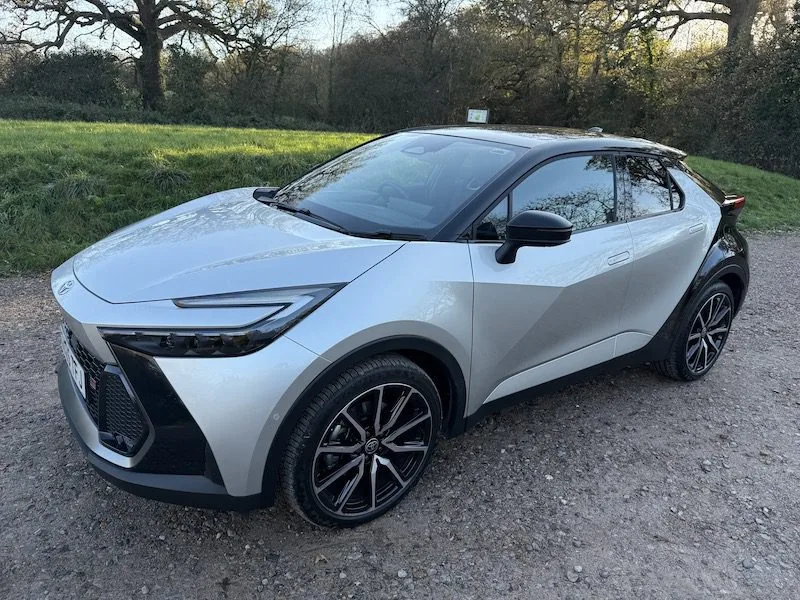
Toyota C-HR PHEV GR Sport (223bhp) Review: Everything You Need to Know Before Buying
The Toyota C-HR has grown up, plugged in and gone premium – but does the range-topper still have the spark that made the original so memorable?
I’ve always had a soft spot for the Toyota C-HR. When the original arrived, it felt like a small act of rebellion from a brand better known for playing things safe. It was sharp, angular and unapologetically different, and crucially, it didn’t try to hide its personality. Better still, in its early years you could even buy one with a petrol engine and a manual gearbox, complete with rev-matching. A crossover that actually wanted to be driven. That alone made it stand out.
This new C-HR feels like the same character several years on. More mature, more polished, far more premium and, inevitably, more expensive. The car tested here is the very top of the range: the Toyota C-HR GR Sport Plug-in Hybrid, producing 223bhp and carrying a price tag that pushes well into the mid-£40,000 bracket. It’s not just the most powerful C-HR you can buy, it’s also the clearest statement yet of how Toyota sees the future of its compact SUV lineup.
To understand this car properly, you need to see it in context. The current C-HR range is entirely electrified. The entry point is a 1.8-litre hybrid producing 140bhp, focused firmly on efficiency and smoothness. Above that sits the 2.0-litre hybrid with 193bhp, which brings a noticeable jump in pace and confidence. Sitting above both is this plug-in hybrid, pairing a 2.0-litre petrol engine with a larger battery and a more powerful electric motor to deliver a combined output of 223bhp. That extra power places the PHEV in a different league to the rest of the range. With a 0–62mph time of 7.4 seconds, it’s around seven-tenths quicker than the 2.0 hybrid and nearly three seconds faster than the 1.8.
In real-world driving, the difference is immediately apparent thanks to the stronger electric assistance at low speeds. It’s still front-wheel drive, still uses Toyota’s familiar e-CVT gearbox and still prioritises refinement over aggression, but there’s no escaping the fact that this is the quickest and most muscular C-HR Toyota has ever built. It’s also the most expensive. Prices start at around £44,000, and a GR Sport like this one nudges higher still, meaning it has to justify itself not just within the C-HR range but against a broader field of plug-in hybrid rivals.
The GR Sport badge needs a bit of context. Despite the name, this is not a Gazoo Racing performance model. There are no mechanical upgrades, no suspension changes and no uprated brakes. What GR Sport delivers is visual drama and equipment. Larger wheels, darker exterior detailing, Alcantara-trimmed seats, a head-up display and a JBL sound system all come as part of the package. It’s best thought of as the fully loaded, design-led flagship rather than a performance variant, and once you approach it with that mindset, the badge makes much more sense.
Visually, the new C-HR continues Toyota’s “concept car for the road” philosophy. The bodywork is a mass of sharp creases and sculpted surfaces, with very little restraint on display. The front end adopts Toyota’s latest design language, giving the car real presence, while flush door handles clean up the side profile and add a layer of modernity. At the rear, the full-width light bar with illuminated C-HR script adds a sense of theatre, complete with a welcome animation. There’s no rear wiper, which Toyota attributes to clever aerodynamics. In theory it works, though British winter conditions may have other ideas. Compared with the original, the new C-HR feels more resolved and more premium without losing its boldness.
For a car with such dramatic styling, the C-HR remains reasonably usable. Boot capacity in the plug-in hybrid stands at 364 litres, broadly in line with the standard hybrids, and Toyota has packaged the battery cleverly to avoid major space penalties. Rear seat space, however, is more compromised. Set the front seat to my six-foot-plus driving position and things get tight. Knees are high, shins are close to the seatback and while foot space exists, longer journeys would be a stretch for taller adults. The panoramic roof adds light, but the rear still feels quite enclosed thanks to small windows and a low seating position. For children it’s absolutely fine, and for average-sized adults it’s manageable, but taller buyers should check it carefully before committing.
Up front, the story improves dramatically. This is where the new C-HR feels properly sorted. The layout is intuitive, the controls are where you expect them to be and nothing feels overcomplicated. The twin 12.3-inch screens are clear and responsive, and in EV mode the car can feel eerily silent around town. There are multiple EV and hybrid modes to choose from, including the option to hold charge, but the car works just as well if you leave it to manage itself. Plug-in hybrids only really make sense if you can charge at home; otherwise, you’ll likely end up driving it much like a regular hybrid. Toyota has struck a good balance between touchscreens and physical controls, with climate functions, demisters, heated seats and steering wheel all easy to access. The infotainment system offers deep customisation without feeling overwhelming, and the overriding impression is that everything works and everything makes sense.
On the road, the C-HR PHEV is easy to live with. Power delivery is smooth, the transition between electric and petrol operation is mostly unobtrusive and refinement is strong. Around town and on decent surfaces, the ride is perfectly acceptable even on the GR Sport’s 20-inch wheels. On broken British roads, however, the suspension can feel brittle, with sharp impacts sending jolts through the cabin. It raises a genuine question about whether the GR Sport’s wheel and tyre combination is worth the compromise if your daily driving involves rougher surfaces. Performance is brisk rather than dramatic. Select Sport mode and the car responds cleanly and confidently, gathering speed without fuss.
At motorway speeds it’s stable and refined, while harder acceleration brings a slightly roarty engine note that adds character. In slippery conditions, a hint of front-wheel scrabble reminds you that all 223bhp is going through the front tyres. Handling is better than you might expect, with good body control, reassuring grip and steering weight that improves in Sport mode. It never pretends to be a hot hatch, but it’s composed and confidence-inspiring. Braking performance is strong, though the feel can be inconsistent as the system blends regenerative and conventional braking, which is noticeable even if it’s not a safety concern.
There’s no escaping the fact that something has been lost along the way. The old C-HR’s wilder edge, and especially the petrol manual with rev-matching, gave it a sense of playfulness this fully electrified generation doesn’t try to replicate. What replaces it is a more mature, refined and capable car. The C-HR PHEV GR Sport feels premium, thoughtfully engineered and impressively efficient. It’s not perfect, and the ride and brake feel are worth considering carefully, but it remains one of the most distinctive small SUVs on sale. Even in an electrified future, personality hasn’t been completely engineered out.