No Country for Young Drivers
Posted by James Ruppert | Aug 22, 2025 | Articles, Bangernomics, Bangerpedia, Bangers and Classics, Books, Car Culture, Car History, Politics
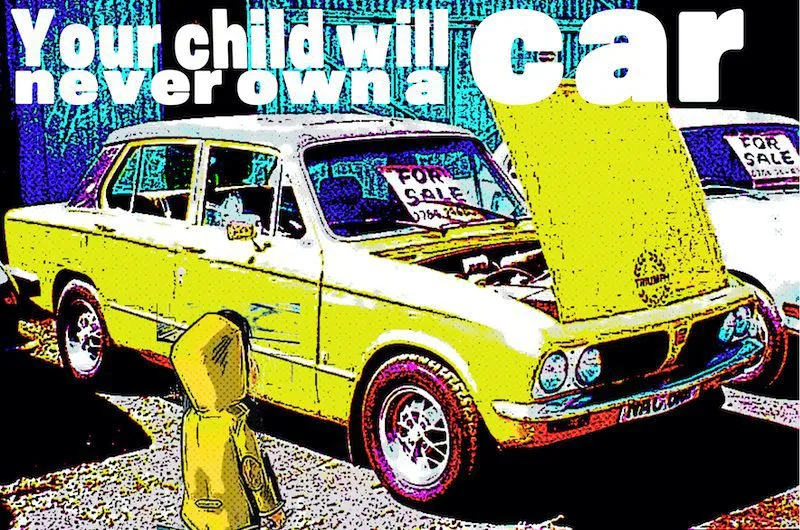
Your Children are unlikely be allowed to drive a car
If the current political and economic trajectory continues, the chances of a youngster, early teen and probably pre teen being able to drive, seems quite remote. That’s your children, grandchildren, nieces and nephews. They will need to have Let me explain.
The simple truth is that young people are being Demotorized and it starts at school. That’s because climate change is integrated into the UK national curriculum for England, particularly within the Science and Geography subjects across both primary and secondary levels. School children learn about the causes of climate change, its effects on the environment, and according to them, the human activities that contribute to it. In particular in science Students learn about the production of carbon dioxide by human activity and its impact on the climate. In geography it includes learning about human and physical processes, how they influence climate, and topics like climate zones and food, water, and energy security. Also in Design and Technology pupils are taught to consider the environmental impact of the products they design. Not only that a new optional GCSE in Natural History will be introduced in September 2025, focusing on environmental issues.
No surprise that there’s a Let’s Go Zero campaign (find out more at letsgozero.org where at the moment I visited their website some 7,184 schools had signed up to become Net Zero by 2030. Just in case you wondered what a zero carbon school is? Well, it’s one that, on its site and through all its activities and procurement, does not contribute to climate change through carbon emissions. Key areas include energy use, travel, waste, water, procurement, food and school grounds.
Seems fairly innocuous, but the propaganda is quite real. Even Primary age children will ask why you don’t have an electric car. If their sponge like minds are exposed to the net zero nonsense, then cars being bad is an easy next step. Indeed, The London Assembly has created the concept of ‘carspreading’. This is because cars are getting bigger, 1cm every two years, and with 52% of cars sold now too large for minimum parking spaces, “Carspreading” is impacting road safety, use of valuable city space and the condition of London’s roads. It is mainly aimed at SUVs and they may of course have a point. However, they are co-opting children into these campaigns. In July a delegation of children from primary schools in South London attended a meeting of Lambeth Council calling on councillors to introduce new parking charges based on the size of a car to discourage supersized SUVs.
Members of Parliament might appreciate the tax revenue from car ownership, but they are keen that youngsters stick to public transport for as long as possible. According to the Transport committee under-22s in England should get free bus travel to access work and training. They also suggested rural weighting for bus funding and a national policy for services in England and urged ministers to reverse a long-term decline in bus travel, which is their main aim here. Last year the Transport Committee said that “This would support access to work and skills opportunities for younger people and help embed long-term public transport use.”
Even if the grown up children are allowed to drive, but will they be able to afford it? Assuming the job they may want to do isn’t already being done by Artificial Intelligence. Learning to drive is an expensive business. Obviously the total cost varies based on location, the hourly rate of the instructor, how many lessons are needed, and whether the test is passed on the first attempt. Applying for a provisional licence costs £34 online. Driving lessons can cost from £25 to £50 an hour. The Driving Standards Agency reckon that it takes 45 hours to learn to drive, so the spend would be just over £1000 or just over £2000 in all. The practical test costs from £62 and the Theory Test is £23 to book. There are intensive courses which might work out cheaper, once the test is passed the next set of expense is going to be buying and insuring the car.
For all drivers the cost of everything is only going one way. have done the sums for us and zeroing in on cars and transportation is a depressing read. I have been critical of the RAC who rarely seem to do much to support or help the average motorist but if you want to see a graph that tracks the relentless upwards curve in motoring costs you will find it here https://www.racfoundation.org/data/cost-of-motoring-index car tax and insurance has undergone the biggest rises and tracking from 2016 it is 2023 to 2024 when the rise has been the most terrifying at over 200%.
Data from the Office for National Statistics shows that prices for new cars are up 40% from 2015 to 2025. Buying a small one will start from a range of £18,500 to £26,000 for a Vauxhall Corsa or Volkswagen Polo. Over this same 10 year period, used car prices are up by 7% and the average first time buyer can of course spend anything they want. The average seems to be around £4000 at the lower end. The key though is what it costs to tax and insure.
The taxation system has become needlessly and deliberately complicated. For most drivers, the cost is £195. However, if the vehicle has a list price of over £40,000 then it may be liable for the ‘luxury car tax’ fee, which adds £425 to the vehicle’s annual VED costs taking it up to £620. Drivers may pay less or more if it was first used before 2017 and the exact fee is dependent on the year of registration and the type of fuel it uses.
When it comes tpo insurance, according to Gocompare in 2024, the average cost of annual comprehensive cover for a 17 year old driver was £1,409.
At the moment though the opportunity to buy a conventional ‘affordable’ internal combustion engined car that is brand new is running out. The UK is phasing out the sale of new petrol and diesel cars starting in 2030, though hybrids will be allowed until 2035.
Anyway, what would be the point in learning to drive when there is the The Automated Vehicles Act? This became law in May 2024, which lays the groundwork for self-driving cars by establishing safety standards. In theory, the UK government aims to have self-driving vehicles operational on public roads by 2026, and some anticipate the first fully autonomous vehicles, quite possibly robotaxis, might take to the roads in 2027.
The future of driving seems quite bleak. Never mind that exciting vehicles, three door hot hatches and sports cars are becoming extinct. Maybe a change of government might change attitudes and laws, but voting rarely changes anything. At the moment this is no country for anyone who needs to drive.
Finally, if you are looking at the latest cover of Free Car Mag, edition 147, if not I will reproduce below, it features a wonderful Jaguar advertisement from back when advertising was very clever indeed. There is a double whammy of truth there because the young lad with bike won’t be able to buy a car not only because it will be too expensive, but there is a massive question mark over whether there will Jaguars worth lusting after, if any at all.
The Substack version of this article will feature three used cars for first time drivers. It will be out at the usual time on Wednesday.