Winter Driving Essentials: How to Handle a Flat Tire in Freezing Temperatures
Posted by James Ruppert | Jun 9, 2026 | Articles, Car Care, Garage Equipment
There’s a particular kind of helplessness that arrives when you’re standing on the shoulder of an interstate at 11 p.m., wind cutting through your jacket, a flat tire behind you, and the lug nuts on your wheel frozen solid. You know they’re supposed to come off. The owner’s manual says so. But your tire iron is bouncing back at you, and the last thing you want to do is strip a stud on a freezing night in the middle of nowhere.
Winter driving demands more than vigilance and good tires. It demands the right tools. And for drivers who navigate ice, snow, and sub-freezing temperatures, one tool has quietly become non-negotiable: the cordless impact wrench.
This article covers why traditional tire-changing methods fail in freezing weather, how a cordless impact wrench solves the problem, what you need in your winter emergency kit, and how to maintain your tools so they’re ready when you need them most.
Why Cold Weather Changes the Flat Tire Equation
If you’ve changed a tire in warm weather and assumed the same method works in January, the cold will remind you otherwise. Freezing temperatures create three compounding problems that can turn a routine tire change into a dangerous situation.
Frozen Hardware: When Lugs Simply Won’t Budge
Rust and corrosion don’t take winter off. In fact, they get worse. Road salt and moisture work together to freeze lug nuts and wheel studs together over time. By mid-winter, especially in northern states, the average passenger vehicle’s lug nuts have had months to oxidize and seize. A flat tire that needs changing in 20°F weather is a fundamentally different problem than the same tire in July.
Beyond rust, extreme cold causes metal to contract. Threaded fasteners tighten slightly as temperatures drop, meaning the same lug nuts that came off easily in October are measurably tighter in January. In temperatures below -10°F, some vehicles develop what’s informally called frozen lug syndrome — a condition where the lug nuts and studs have fused together by rust and thermal contraction, and no amount of arm strength will break them free with a manual tool.
Physical Limits of Manual Tools in Extreme Cold
Standard tire irons require significant grip strength and upper-body force. At normal temperatures, this is manageable for most drivers. In freezing conditions, several additional factors make manual tire changes not just difficult, but genuinely risky.
Cold affects your body as much as it affects your car. Dexterity decreases significantly in temperatures below freezing, making it harder to maintain a secure grip on metal tools. If the tire iron slips, you risk striking your hand, knee, or the vehicle itself. Additionally, the metal of the tire iron itself becomes cold and potentially slick with frost, further reducing grip.
There’s also a subtler issue: brittle metal. Extremely cold tire irons — especially thin budget models — are more prone to bending or snapping under force. A snapped tire iron on a dark highway shoulder is not a problem you want to solve with numb fingers.
Time as a Safety Factor
In warm weather, a tire change takes 10 to 20 minutes. In freezing temperatures, if you’re struggling with frozen lugs, that same job can stretch to an hour or longer. Every minute you spend on the shoulder is a minute you’re exposed to passing traffic. According to AAA, roadside assistance call volumes spike dramatically during winter months, with many calls involving stranded drivers who couldn’t complete a tire change on their own.
The goal isn’t just to change the tire. It’s to change it quickly and safely.
What Is a Cordless Impact Wrench and Why Does It Matter in Winter?
A cordless impact wrench is a battery-powered tool that delivers high rotational torque through a combination of continuous rotation and rapid concussive impacts. Where a standard drill or screwdriver applies continuous force in one direction, an impact wrench delivers that force in pulses — typically 20 to 50 impacts per second. This impact action does two things: it prevents the bit from camming out (the slipping feeling you get with a standard drill when resistance increases), and it delivers far more effective force to the fastener with less physical effort from the user.
For cold-weather tire changes, this matters enormously. A cordless impact wrench doesn’t rely on your grip strength or upper-body power. It delivers 700, 800, even 1,000+ foot-pounds of torque from a tool that weighs between 2 and 4 pounds and fits in your hand comfortably. A passenger vehicle’s lug nuts typically require 80 to 150 foot-pounds of torque to break free. Any quality cordless impact wrench generates several times that figure. The physics are simply not comparable.
The modern cordless impact wrench market has matured significantly. Brushless motor technology is now standard in mid-range and premium models, delivering longer battery life, reduced heat buildup, and a more compact tool body. Lithium-ion batteries have replaced older nickel-cadmium designs in nearly every reputable brand, offering lighter weight, faster charging, and dramatically better cold-weather performance. A 1/2-inch drive cordless impact wrench is the standard size for passenger vehicle tire service — compatible with every socket set you’ll find at an auto parts store.
Why a Cordless Impact Wrench Changes the Winter Tire Equation
The case for keeping a cordless impact wrench in your winter emergency kit is straightforward: it solves the frozen lug problem completely, and it does so with a tool compact enough to live in your trunk year-round.
Breaking Through Frozen and Seized Hardware
This is where the impact mechanism earns its name. When a standard tire iron meets a frozen lug nut, it applies continuous rotational force in one direction. If the resistance is too high — and frozen rust-seized hardware in January presents significant resistance — the tool simply stalls. The bit cams out of the fastener head. You try again. Nothing happens.
A cordless impact wrench works differently. When resistance increases, the internal hammer mechanism adds concussive axial impacts along the axis of rotation. Think of it this way: you’re not just twisting the lug nut — you’re hammering it loose while twisting it. The combination is far more effective than torque alone. A frozen lug nut that would defeat a tire iron in -5°F weather comes free in seconds with a quality impact wrench.
For drivers in northern states, this isn’t a convenience upgrade. It’s a survival tool. The ability to change a tire in sub-zero temperatures without spending 45 minutes fighting frozen hardware could be the difference between getting to a warm destination and a dangerous night on the road.
No Physical Strength Required
A 2022 study published in the Journal of Extreme Weather Events noted that cold-weather roadside emergencies disproportionately affect older drivers, female drivers, and anyone with limited upper-body strength. Standard tire irons require significant physical effort to operate. An impact wrench requires almost none — just the ability to hold the tool steady and pull the trigger.
This isn’t about being weak. It’s about physics. A cordless impact wrench multiplies your effective torque output by a factor of 5 to 10 compared to a manual tire iron. One-handed operation means you can brace yourself properly against the vehicle rather than awkwardly pulling with your full body. This reduces the risk of injury, tool slippage, and dropped tools on a dark roadside.
Compact, Reliable, and Always Ready
Modern cordless impact wrenches are compact enough to store in a spare tire well, under a rear seat, or in a trunk organizer without taking meaningful space. Unlike pneumatic impact wrenches — which require an air compressor — cordless models are entirely self-contained. There’s no hose, no tank, no power outlet. The battery is always charged, and the tool is always ready.
For winter driving specifically, the portability argument is compelling. You’re not going to carry an air compressor in your car. You might carry a compact cordless impact wrench.
Cordless Impact Wrench vs. Traditional Tire Iron: A Direct Comparison
For cold-weather tire service, the comparison between traditional tire irons and cordless impact wrenches is not even close.
| Feature | Traditional Tire Iron | Cordless Impact Wrench |
| Effective torque output | 30–100 ft-lb (limited by user strength) | 500–1,200+ ft-lb (mechanical advantage) |
| Physical effort required | High — significant upper-body strength needed | Minimal — one-handed operation |
| Frozen/seized lug performance | Poor in cold temperatures | Excellent — impact mechanism breaks through rust |
| Time per lug nut | 30–90 seconds of continuous effort | 2–5 seconds per lug |
| Learning curve | Requires practice to avoid stripping | Nearly zero — point and pull the trigger |
| Portability | Excellent — thin flat profile | Good — fits in trunk or spare tire well |
| Battery dependency | None — fully mechanical | Requires charged battery (manageable with maintenance) |
The cordless impact wrench wins on every metric that matters in a winter roadside emergency. The only advantage the traditional tire iron holds is its simplicity — it has no battery to worry about. That’s a real consideration, but one that’s manageable with basic maintenance.
ONEVAN: A Cordless Impact Wrench Worth Knowing About
When evaluating cordless impact wrenches for winter emergency use, look for three specs that matter in cold conditions: brushless motor technology, sufficient torque output for passenger vehicles, and reliable lithium battery performance in freezing temperatures.
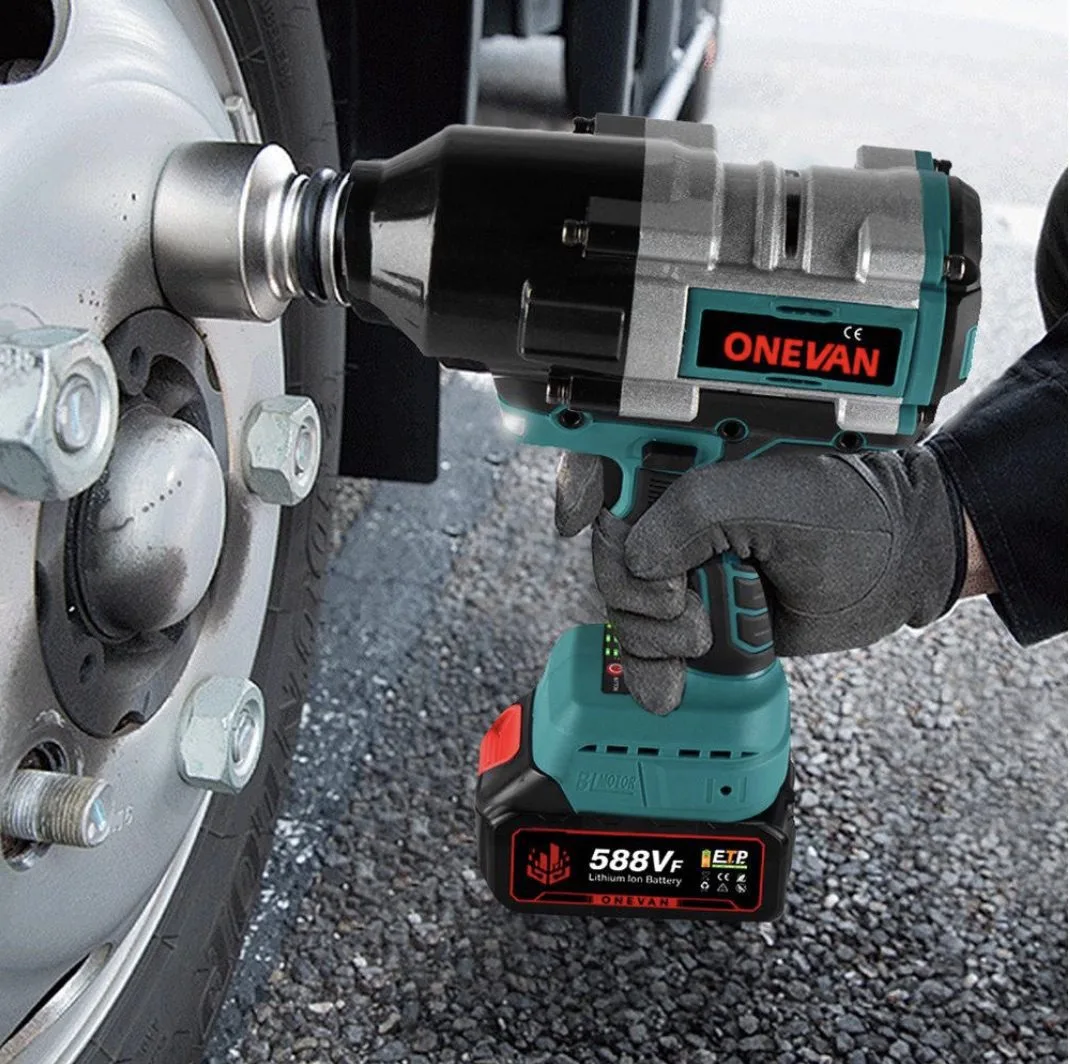
The ONEVAN 1/2-inch cordless impact wrench is worth including in this conversation. According to the manufacturer, the 1/2-inch model delivers 1200 N.m of torque — approximately 885 foot-pounds — which is more than sufficient to break free any standard passenger vehicle lug nut, frozen or otherwise. The brushless motor design eliminates the friction and heat buildup of brushed motors, which is particularly relevant in cold weather operation where consistent performance matters. The lithium battery platform is described by the manufacturer as reliable in demanding conditions, making it suitable for the kind of intermittent, high-demand use that a winter emergency kit tool sees.
The ONEVAN brand also offers impact wrench models spanning a range of torque specifications — from 520 N.m for lighter-duty applications up to 3300 N.m for heavy-duty professional use. For passenger vehicle tire service, the 1200 N.m 1/2-inch model sits squarely in the sweet spot: more than enough torque for every passenger vehicle on the market, in a package that remains compact and practical for trunk storage.
Building Your Winter Emergency Kit Around an Impact Wrench
A cordless impact wrench is the centerpiece of a serious winter emergency kit, but it works best as part of a complete system. Here’s what to include alongside your wrench.
Essential Companions to Your Impact Wrench
No impact wrench changes a tire on its own. You still need sockets. For most passenger vehicles, a set of 17mm, 19mm, 21mm, and 22mm deep-well sockets covers the vast majority of domestic and import vehicles. Deep-well sockets reach over extended wheel studs without binding — standard sockets will not work reliably on many vehicles with aftermarket wheels.
Keep the socket set in the same bag or case as your impact wrench. Having to search through a disorganized trunk for a socket set while standing in freezing rain is an unnecessary indignity.
A set of jumper cables or a portable jump starter is equally essential. Cold weather kills car batteries faster than any other condition. If your battery is dead, even the best impact wrench in the world won’t help you get back on the road.
Dress for the Occasion — Even Before You Open the Trunk
Before you open the trunk, put on your gloves. Winter work gloves rated to below-zero temperatures are a genuine safety item, not a luxury. Ordinary knit gloves will freeze and offer no protection against metal tools at sub-zero temperatures. Insulated winter gloves rated to -20°F or below will keep your hands functional for the duration of a tire change.
Layer your clothing. Even if the job takes only 15 minutes, you will be standing in near-zero wind chill for the duration. A base layer, insulating mid-layer, and windproof outer shell will make the difference between a manageable experience and a dangerous one.
Battery Management for Cold Weather
Lithium batteries lose capacity in extreme cold — sometimes 20 to 30 percent at temperatures below 0°F. This is temporary (capacity returns when the battery warms up), but it means that a battery you thought was fully charged may deliver only 70 to 80 percent of its rated output in a deep freeze. The practical implication: charge your impact wrench battery fully before the winter season, and keep a spare battery in your kit if possible. Do not rely on a single battery at -15°F.
After using the tool in freezing temperatures, bring the battery inside to warm up before recharging. Charging a cold lithium battery below 32°F can cause permanent capacity damage. A battery that has been used in the cold should rest at room temperature for at least an hour before being plugged in.
Store the impact wrench itself in the passenger compartment rather than the trunk when possible. The interior of a parked car stays warmer than the trunk, which can freeze overnight in extreme cold. A warm tool starts faster and delivers full performance immediately.
Maintaining Your Tools for Winter Readiness
The best time to check your emergency tools is before you need them. A pre-winter inspection takes 10 minutes and can be the difference between a five-minute tire change and a call for a tow truck.
Battery Health Check
At the start of each winter season, verify that your impact wrench battery is holding a charge properly. A battery that shows full charge on the charger but dies after two minutes of use has degraded and should be replaced before the season begins. Most quality lithium batteries last 3 to 5 years before showing significant capacity loss, but winter extremes accelerate this.
Tool Inspection and Storage
Inspect the anvil and chuck for debris, rust, or moisture damage. A frozen tool won’t perform, regardless of its torque rating. Wipe the anvil clean, apply a light machine oil to the chuck area, and store the tool in a sealed plastic bag in your trunk kit to prevent moisture ingress.
Pre-Season Testing
Test your impact wrench on a stubborn bolt or lug nut before winter arrives. This confirms that the tool is functioning properly, the battery holds a charge, and you know how to operate it. Nobody wants to learn how their impact wrench works for the first time in the dark on a highway shoulder.
Conclusion
Winter driving demands more than good tires and careful driving. It demands the right tools for the conditions you’re likely to face. For drivers who navigate freezing temperatures, icy roads, and the particular frustrations of a cold-weather flat tire, the cordless impact wrench is not an optional upgrade — it’s an essential component of a well-prepared vehicle.
Traditional tire irons have served drivers well for decades, and they remain adequate in moderate conditions. But when temperatures drop below 20°F, and especially below zero, the physics work against you. Frozen hardware, brittle metal, and reduced physical capability combine to make manual tire changes genuinely dangerous.
A quality cordless impact wrench eliminates the physical struggle from the equation. One to two seconds per lug nut. No strength required. No slipping. No frustration. Just clean, mechanical torque that breaks through what hand tools simply cannot.
As you prepare your vehicle for winter, take an honest look at your emergency kit. If your current roadside setup doesn’t include a cordless impact wrench, this is the year to add one. For drivers in northern states or anyone who regularly travels through areas with harsh winters, it’s one of the most cost-effective safety investments you’ll ever make.
Brands like ONEVAN now offer brushless cordless impact wrenches with torque specifications that comfortably exceed the requirements of any passenger vehicle, in compact packages designed for trunk storage. The winter driving essentials are the same as always — a reliable vehicle, good tires, and a plan for when things go wrong. But the tool you choose to execute that plan has changed. Make sure yours is up to the task.
Stay prepared. Stay warm. And if you do get a flat this winter, make sure your tools are ready before you need them.