1986 Toyota AE86 Corolla GT Coupé
Posted by James Ruppert | Apr 3, 2026 | Articles, Brown Car Guy, Car Culture, Car History, Car Manufacturers, Classic Cars
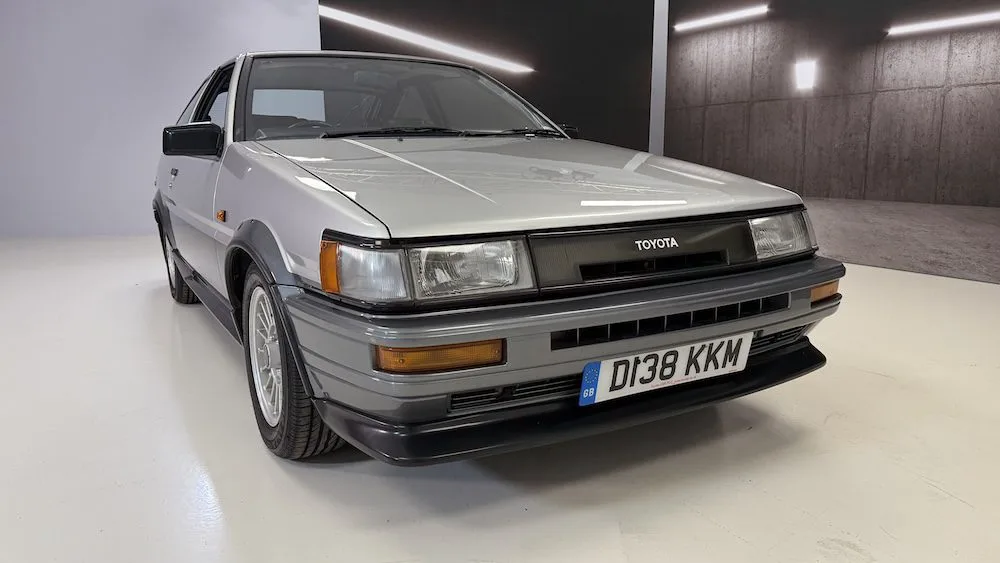
1986 Toyota AE86 Corolla GT Coupé Review
Does the legend of the ‘Hachi-Roku’ from the mid-80s live up to the reality of driving one in the 2020s?
Remember the Eighties? When the world ran on optimism, synth-pop and questionable fashion choices? I personally sported a pastel green blazer in crinkled material with roll-up sleeves and shoulder pads large enough to land Airwolf on. But you know what? Best decade ever in my not-so-humble opinion. Especially for music, movies and motors.
So imagine my delight when Toyota handed me the keys to something straight out of that era: their own 1986 Toyota Corolla GT Coupé, better known to you, me and every manga-obsessed drift fan on earth as the AE86 Hachi-Roku.
The car itself has an unusual backstory. If you’re wondering why it doesn’t have the pop-up lights of the car in the legendary Initial D series, that’s because Japan had two versions: the Sprinter Trueno with pop-ups, and this fixed-headlight version known as the Corolla Levin. Mechanically identical, both were already oddballs when they launched in 1983 with the E80 Corolla generation.
While the rest of the Corolla range boldly marched into front-wheel-drive modernity, these liftback coupés stubbornly clung to the rear-wheel-drive platform of the outgoing E70. Toyota’s engineers must have known they were quietly creating something special. Few others realised that this humble two-door Corolla would become a drifting deity, cult hero and the favourite instrument of drivers who believe corners should be artistically interpreted.
We got the Levin only in the UK. Toyota’s pristine example was originally priced at £8,799, with another £261 for the rather lovely two-tone silver paint. Today, clean cars easily fetch well north of £20,000 if you can find one.
And just look at it. Those sharp creases and character lines are pure 80s design confidence. Against today’s wind-tunnel-approved blobs, this Corolla Coupé has a charm that’s hard to explain. You simply feel it.
This particular AE86 isn’t for sale. It’s part of Toyota UK’s heritage collection, and it’s been sympathetically modified in period style. There’s a Cusco strut brace, lowered suspension, Whiteline anti-roll bars, an Apexi induction kit and a Janspeed exhaust. Nothing outrageous. Just the sort of upgrades a proud owner might have fitted between mixtapes.
Inside, the cabin is a glorious 80s time capsule. Slim pillars flood the interior with light, the velour upholstery feels wonderfully plush and the cassette player made me wish I’d brought a stack of Paula Abdul tapes. There’s even a quartz digital clock.
The rear seats are surprisingly usable too. In a moment of questionable judgement I squeezed my 6ft 1in frame into the back. I wouldn’t volunteer for a cross-country trip back there, but I got in and out without dislocating anything, which counts as success.
Even with the seats upright the boot offers 255 litres of space, proof that people in the 80s carried actual luggage rather than seven charging cables and a gym bag full of hope.
Then came the moment I’d been waiting for: sliding into the driver’s seat. The view ahead is pure sports coupé theatre. Clear analogue dials, rotary switches for lights and wipers, a single indicator stalk and a tall gear lever that snicks satisfyingly into place. Before the wheels had even turned, the car had already charmed me.
Out on the road the AE86 wakes up beautifully. The clutch is feather-light and the car moves with eager sweetness. The unassisted rack-and-pinion steering, heavy when parking, comes alive as soon as the car rolls. It buzzes gently through your fingertips like it’s saying, “You and me, let’s go.”
Then there’s the 4A-GE engine. That metallic rasp when it spins is addictive. It doesn’t shove you into the seat but it constantly invites you to rev it harder. At 4,500rpm the sound becomes eager. By 6,500rpm it’s pure rock-star energy.
Barely minutes into the drive I’d already collected two enthusiastic thumbs-up. One from a pedestrian crossing the road and another from a bloke in a burly AMG who pulled alongside, beeped and grinned. Imagine that: modern German muscle saluting an old Corolla.
That’s the magic of the AE86.
Once the roads opened up, the chassis began to dance. It’s light, eager and playful. Even in the wet it clings to the road impressively. People assume these cars slide everywhere, but in reality they’re remarkably planted unless you provoke them. What you do sometimes feel is a tiny rear-end wiggle, just the suspension and tyres chatting quietly with each other.
The brakes needed some warming up but once working properly they’re perfectly adequate for a car weighing just 970kg. You feel the weight transfer, the nose dip and the rear tuck neatly into the corner.
On paper the numbers are modest: 123bhp, 0–62mph in 8.3 seconds, and 122mph flat out. Economy sits somewhere between 31 and 45mpg if you drive sensibly. Which I absolutely did not.
The verdict? Simple. The AE86 is a masterpiece. No gimmicks, no artificial drama, just an engine, a five-speed gearbox and a beautifully balanced chassis. It reminds you what driving is supposed to feel like.
If you want one, be prepared. Good examples are rare and expensive. Check carefully for rust, inspect suspension mounts and make sure the engine has been properly maintained. The 4A-GE is tough, but neglect shows quickly.
As for me, I stepped out of Toyota’s AE86 grinning like it was still 1986. What a privilege. What a joy. What a car.