The Arrow Range – the last all-Rootes cars.
Posted by James Ruppert | Sep 2, 2026 | Articles, Car Culture, Car History, Classic Cars
The Arrow Range – the last all-Rootes cars.
by Nigel Hughes, Singer Owners Car Club.
October 5th and 19th this year, will mark the 60th anniversary of the launch of two very well-known and popular cars of their time, which once were a common sight on virtually every road in Britain – the Hillman Hunter and Singer Vogue Mk V. The new Hillman Hunter revived an old Singer name – and the upmarket Singer version would become the last big Singer ever built. The Arrow range of cars, were to be the last all-Rootes designed and built vehicles, as throughout the 1960’s, Chrysler Corporation were fast buying up Rootes shares to complete a take-over.
The Arrow range of cars was one that encompassed the entire Rootes passenger car range covering Hillman, Singer, Sunbeam and Humber variants. It was a unique line-up in the British car market, forming the biggest range of cars ever produced and marketed using a common body and engineering. They were once as popular a car on our roads as you could see, yet today, they are amongst the rarest and most under-valued of our much-loved classics of the 60’s. 470,000 Hunters were built for the home market and it is estimated there are around 100 Hunters left and of the 47,000 Vogue Mk V’s built, just 17 are noted as remaining on Britains roads.
In terms of their sporting prowess, the majority did not go on to win many gold medals, except of course for the few hair-raising Hunter GLS, Rapiers and Rapier H120’s and of course there is that remarkable London to Sydney Hunter that took everyone by surprise – even its manufacturer was unprepared for victory and nearly missed its considerable publicity opportunities.
Today they represent a range of cars that are timeless classics – elegant, comfortable and reliable to drive and travel in. They are easy to find mechanical parts for (although like so many classics, trim is always scarce to find) and working on them is very easy, making them a great useable practical classic for everyone.
Both the Hunter and Vogue share the same engine – the re-engineered, tried and tested Rootes’ over-square, 5-main bearing engine, which produced 80 bhp from the 1724cc unit (81.5 X 82.55 mm) with a single Stromberg 150 CDS carburettor and 8 port Alpine, aluminium head. A 12v alternator was fitted as standard. The engine was canted over 10 degrees, to allow for better carburettor clearance – not to give a lower bonnet line as advertising stated, and was matched to a smooth power train through a four speed all synchromesh gearbox, with overdrive and Borg Warner 35 automatic options being available at extra cost.
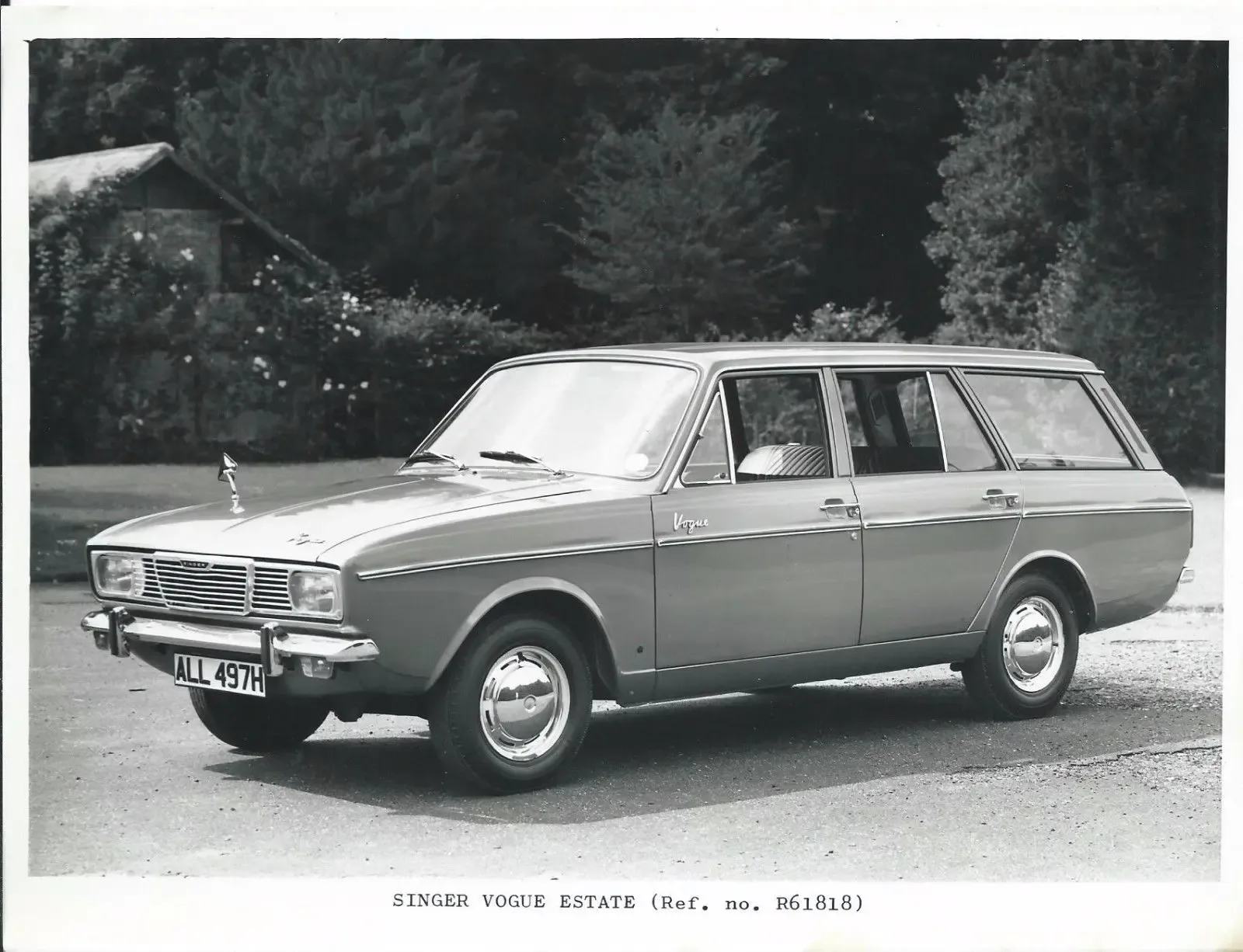
Pressed Steel at Cowley were to build the bodies in saloon version only at first and interestingly the Hillmans would be painted at Cowley to be sent by rail to Ryton for assembly but the Singer shells were sent in a protective spray primer (It was only the Singers that were treated in this way) for painting in Coventry and assembly in Ryton. This was because the new Vogue was to be offered with 11 colours, that were initially, to be unique to the new Vogue. The Rootes, Ryton on Dunsmore plant was well recognised in achieving high standards of mass production fit and finish and the new cars were no exception and with their modern lines, they made a significant modern replacement for the earlier Super Minx range of cars, models, which had been in production for five years.
By the summer holiday shut down of 1966, Rootes had stockpiled thousands of the new Hunter and Vogue cars and once back the assembly lines were filled by more and more of the new models, in readiness for the formal launches. Once the cars came off the production line, they were driven out of the main factory, the short distance along the A423 and parked on huge fields opposite. For a number of weeks, the run out of the earlier models resulted in production of Super Minx and Minx variants alongside the new Hunters and Vogues, while over at Carbodies factory in Holyhead Road the last Vogue Estates were built up. In November 1966 Pressed Steel would begin supplying fully built Vogue Estate bodies and the firms long standing link with Carbodies in Coventry would come to an end.
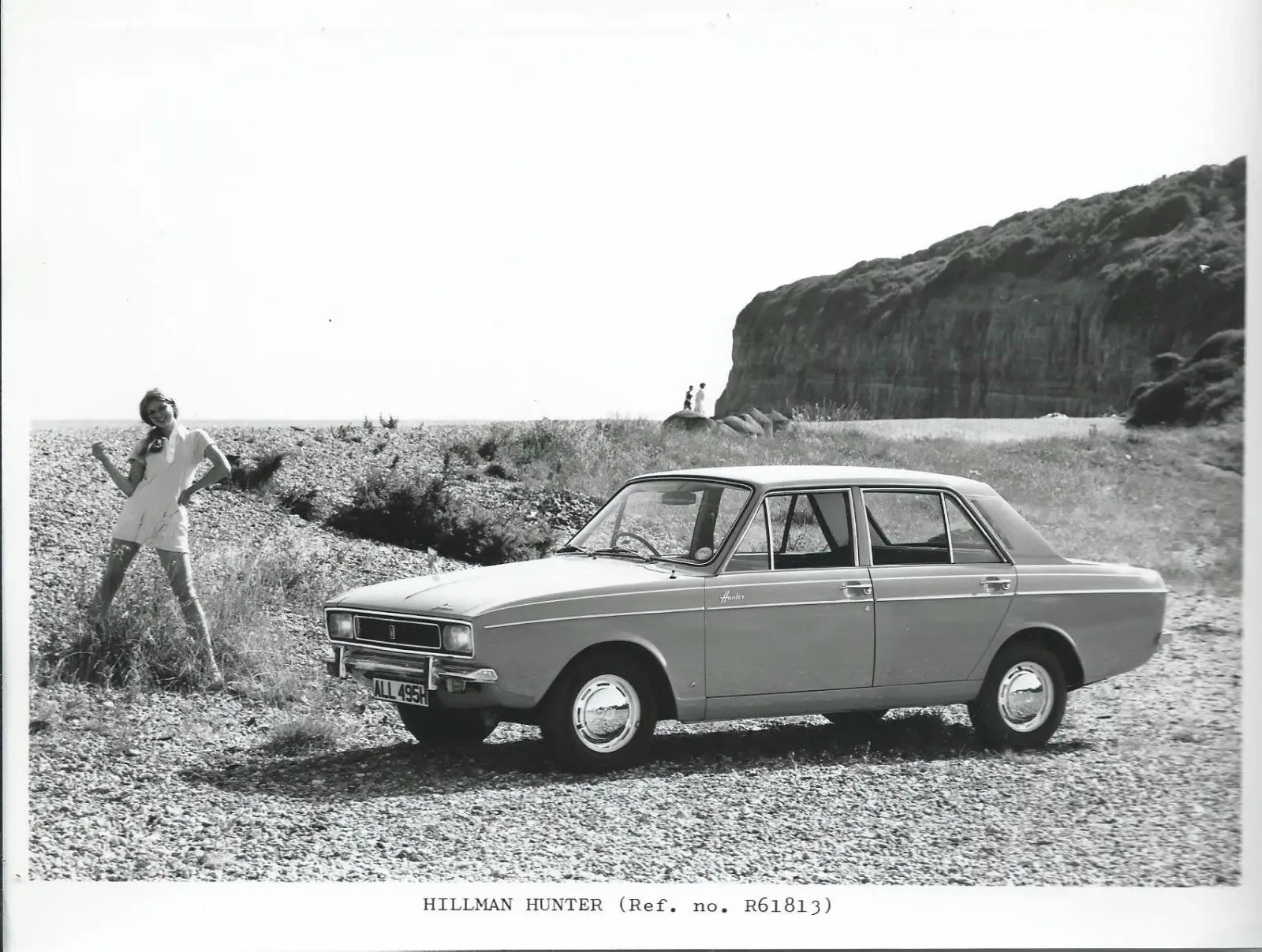
The Rootes marketing department planned lavish and impactful launches for the two new cars and the public were not disappointed – the first would be the Hillman Hunter at the Paris Motor Show at The Salon, Porte de Versailles, on 5th October 1966 – known as the Mondial de l’Auto this was historically a massive, grand international event, attracting over 500,000 visitors. Recognised as the oldest motor show in the world, originating in 1898, it formed the perfect arena to launch such this important new Rootes car to the world. The stand consisted of the new cars, with attractive models sporting hunting and riding outfits in attendance. For once, Rootes stole Fords thunder, just beating their rivals Mk II Cortina’s launch and Ford were not pleased to have been outdone!
The new Hunter was available priced at £680 0s 0d basic, with purchase tax adding another £157 11s 0d making a total of £837 11s 0d – £34 dearer than the Cortina!
The Singer Vogue in true flamboyant Rootes’s style, was formally unveiled on another impressive all Singer stand at the London International Motor Show at Earls Court on 19th October. In the 1960’s the four Rootes passenger car brands – Hillman, Humber, Sunbeam and Singer all had their own individual stands at the Motor Show, but this would change in 1968 with a new combined all-Rootes stand, on which every car displayed was Polar White in colour.
Stand 118 was the Singer stand and the marketing department designed an eye-catching display of the new model – one with no doors and “B post” removed to show off the interior to best effect. The decision was made that given the lighting of the Main Hall and the location on the ground floor of the Singer stand, the best colours would be Sherwood Green Metallic and Silver for the 2 new Vogue exhibits. Other cars on the stand would be the Chamois and Chamois Sport, a Series VI Gazelle (making it the Audax bodied ranges 11th and final appearance) and a Mk IV Vogue estate, which was also making its last appearance before replacement by the new Vogue estate in April 1967.
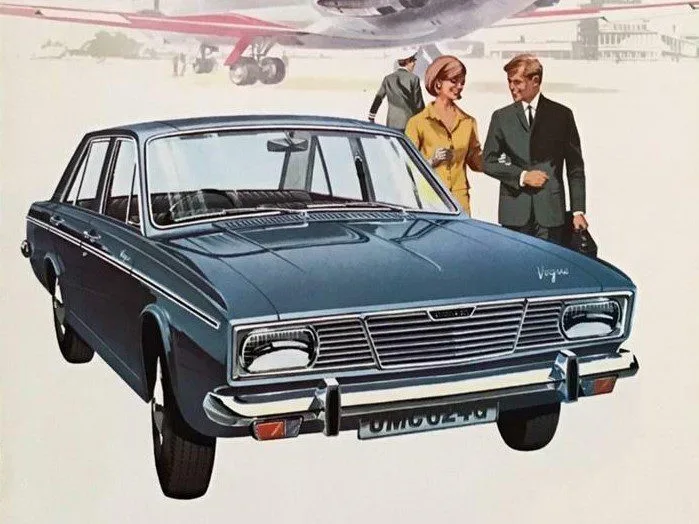
The new Vogue attracted a lot of interest – marketed as the first British car fitted with rectangular headlamps and the first to have Amblair upholstery. The body incorporated a full width grille of horizontal bars with a raised centre panel and the Singer badge on its peak. A broad chrome twin stripe ran down the sides of the car and a single stripe across the boot lid. Chrome was much in evidence on both cars but the Vogue was highly trimmed. The Hunter was given traditional round headlights, a functional interior trim and less chrome, but it still looked every bit an attractive, stylish, quality car.
The basic price of the Singer Vogue remained the same as the earlier model at £740. 0s 0d with £171.6.1d p/t. giving a total of £911 6s 1d. Overdrive and Borg Warner 35 automatic transmission were available at extra cost along with a number of other options.
An extensive range of exterior and interior colours included Polar White, Midnight Blue, Embassy Black, Maroon, Sherwood Green Metallic, Burnt Almond Metallic, Silver Grey Metallic, Gunmetal Metallic, Golden Sand Metallic, Claret Metallic and Shadow Blue Metallic, (metallic paint finishes were a no cost standard item) with now fewer than six contrasting interiors coloured in Ochre, Red, Tan, Black, Navy and Green.
The Singer stand was located close to the Philbeach Entrance, with Riley, Porsche, Triumph and Austin-Healey as neighbours alongside. The new Hillman Hunter was located on the Hillman Stand 126 in the centre of the main ground floor hall.
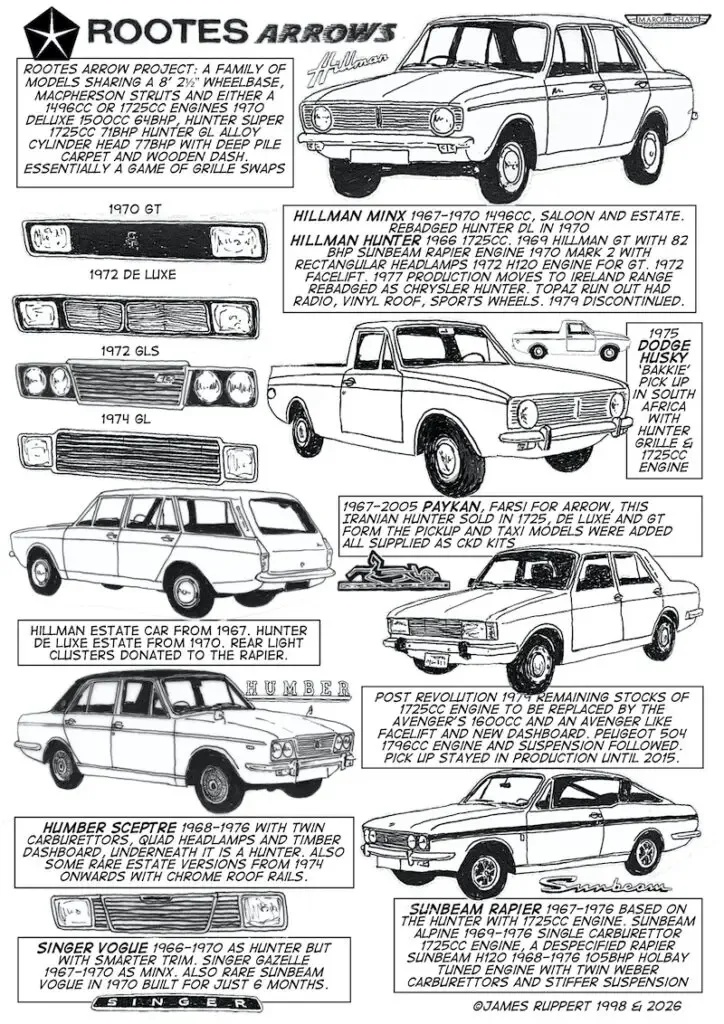
The design and robust mechanics of the cars suited many overseas markets, but the biggest order came when a major export contract was signed, when the Arrow was selected by the Iranian government to become the new national medium sized car which resulted in Hillman Hunters being exported to Iran in CKD (Completely Knocked Down) kits throughout the 1960s and 1970s. Named Paykan (Paykan is Farsi for Arrow), production began in 1967 under a license from Rootes, and the car went on to become an iconic part of Iranian life and much favoured national vehicle in Iran. Initially production began at 6,000 units per year, eventually increasing over the years to millions during its production run. When production in Britain cased in 1979, the tooling was bought and shipped to Iran where they continued to be built as Paykan saloons until the 2005 and a pick-up version until 2015—to this day this was one of Britain’s biggest ever export deals and no photograph or film footage from Iran at the time was short of a Hunter or two in the background!
January 1967 was to be the tipping point in the colourful and hugely successful Rootes’s history, when Chrysler finally managed to gain control of the Group. As if to remind everyone who called the shots from now on all new Rootes products would carry the Chrysler Pentastar badge – fitted on the near side front wing.
In April 1967 the new Vogue Estate car was launched with a down-tuned 73 bhp 1725 cc engine which was fitted with a cast iron cylinder head and dynamo; however, this was altered to the higher saloon specification in October 1967. Despite manufacturing 184,243 vehicles and taking a 12.1% market share in 1967, the Group made its biggest ever loss to date of £10.8 million. Prices of the Singer Vogues were increased on 10th October 1967 – basic £755 0s 0d plus p/t £174. 14 10 making a total of £929 14s 10d
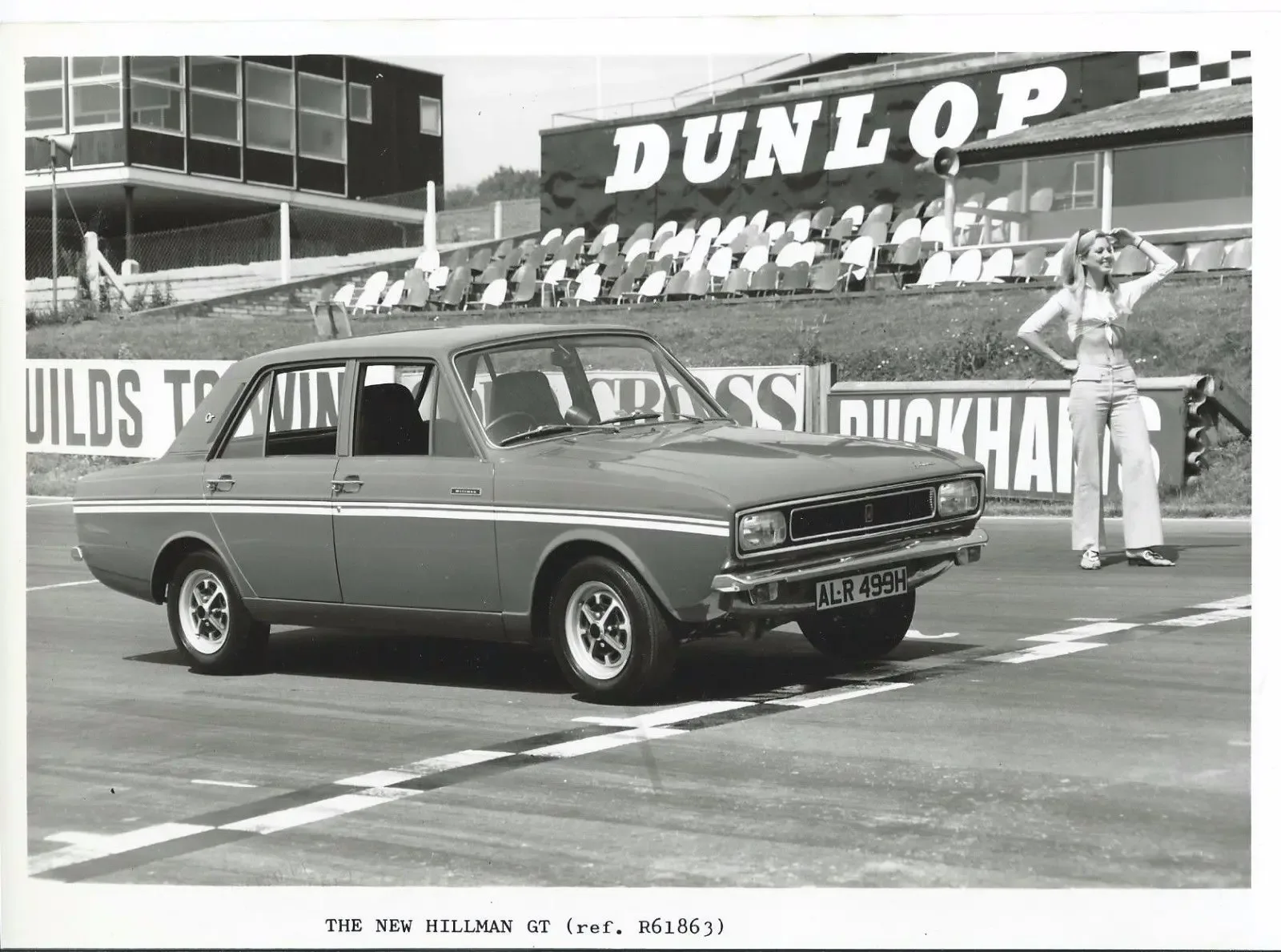
On the 28th September, 1967, the Hunter was given a face-lift becoming the Hunter Mk II in the process. This gave the car a revised front grille incorporating the Vogues rectangular headlights and other trim improvements. In September 1968 servo assisted front brakes became standard on the Hunter and Vogue and the tail gates of the estates were given a handle rather than a push button lock lift.
All though this period the Hunter was a leading car in the top tier of Britain’s best-selling vehicles and its success was about to be boosted by a remarkable race result.
On November 24th 1968, at Crystal Palace in London, Miss Australia flagged away the first car, in what was to be the London to Sydney Marathon – a total of 92 cars were entered and only 53 would finish and the one that won (and admittedly it did so by a very lucky opportunity) was a Hillman Hunter.
Most of the world’s major motor manufacturers entered teams: BMC, Ford UK, Ford of Germany, Ford of Australia, General Motors of Australia, Rootes, Daf, Volvo, Simca, even Moskvich and a number of private entries were accepted.
The Rootes Hunter entry was overseen by Marcus Chambers manager of the Rootes competition department (interestingly, Marcus Chambers favoured transport at that time was a white Singer Vogue estate) which after a gruelling 10,000-mile journey saw Scottish farmer Andrew Cowan grasp victory when he took the lead after the Belgian driver Lucien Bianchi crashed with only 100 miles to go. This amazing result was totally unexpected back home in England and Chrysler were very much caught on the backfoot in terms of being ready to exploit such an outcome. Within hours the Rootes marketing machine was in full swing producing a series of Marathon based adverts proclaiming the tried and tested virtues of the Hunter and its consorts, which had so dramatic an effect on the public’s interest and regard for the car that it became Britain’s No 4 best-selling car in 1969 and spearheaded a raft of additional sales well into the early 70’s. But Marcus Chambers (Rootes Competition Team manager) was not impressed and openly made clear his thoughts of the lack of preparedness for so significant a result. Perhaps not surprisingly, with Chrysler trying to save money at every opportunity, 1969 would see the end of the Rootes Competition Department.
In October 1969, the Singer Vogue’s expensive Amblair upholstery, was replaced with a cheaper soft grain upholstery, and the distinctive Vogue script badges were replaced with a modern 60’s square blocked style badge. A heated rear window was now also offered in the Vogues as an optional extra and there came yet another price increase, lifting the cost of the cars to £818 0s 0d. p/t of £252 4s 9d total £1,070 4s 9d.
Just as Rootes before them, Chrysler were by now in big trouble. Despite huge capital investment in plant and equipment they were unable to stem the mounting losses and, in an attempt, to remedy the situation, the now Chrysler dominated Board embarked upon a major rationalisation of products and vehicle ranges and a decision was made to end the Singer marque and perhaps even more bizarrely, end production of what had once been the backbone of Rootes – the Minx.
With a new generation of car about to be launched – the Hillman Avenger, the entire Hunter range assembly was moved up to Linwood to free up space at Ryton to build the Avenger.
A formal announcement came on 2nd March 1970 in a brief press release announcing that the name of Singer was to be dropped and models after 1st April 1970 rebranded Sunbeam. But that was not the end of the Singer Vogue Mk V story, since Singer cars continued to be produced in the Todd Motors, Petone plant, outside Wellington in New Zealand for a further 12 months, where the special factory had been set up to assemble CKD Singers there.
The Arrow range of cars went on to be produced in four distinct face lifts under the Hillman, Humber, Sunbeam and Chrysler names for the following 8 years.
Today Hunter cars are a very rare sight on our roads. The early ones are the best, as after August 1968, Chrysler cost-cutting measures, progressively cheapened the product and removed much of the quality that Rootes were renowned for.
On the 30th June 1970, the Rootes Group was rebranded Chrysler UK and just like Singer, the last vestiges of a once great British motoring name came to an end.
Join the Singer Owners Club, you won’t regret it